

Under Deck Insulation Manufacturer in India
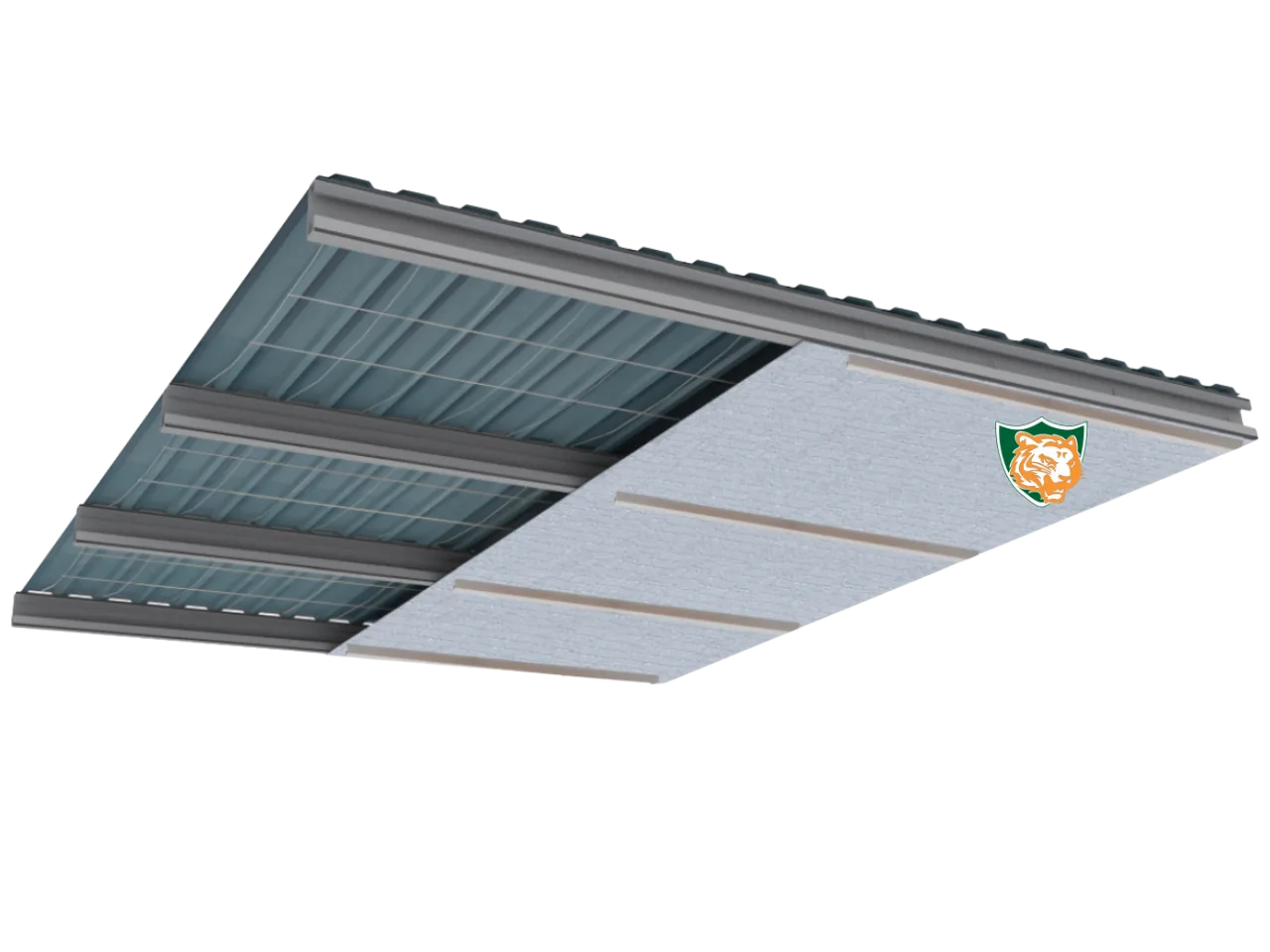
TigerShield™ manufactures high-performance under deck insulation sheets for factory owners, warehouse operators, PEB contractors, and building managers across India. Unlike overhead roof insulation that requires dismantling your existing roof, under deck insulation installs directly to the underside of your roof structure — making it the fastest and most cost-effective way to cool an existing building. Our reflective bubble under deck insulation blocks up to 97% of radiant heat, reduces interior temperatures by 8°C, and is fire-retardant, moisture-proof, and lightweight enough to install without modifying structural members. Made at our Faridabad facility. Pan-India delivery from Delhi NCR within 24–48 hours.
📞 +91 9810004006 for site assessment | 📧 [email protected] | ⚡ Same-week dispatch across India
What is Under Deck Insulation?
For Indian factory owners, warehouse operators, and building managers, under deck insulation is the most practical retrofit option because it:
- Requires no roof removal
- Installs in days, not weeks
- Doesn’t disrupt operations below
- Works on every roof type — metal, RCC, asbestos, cement
- Costs a fraction of replacing the entire roof system
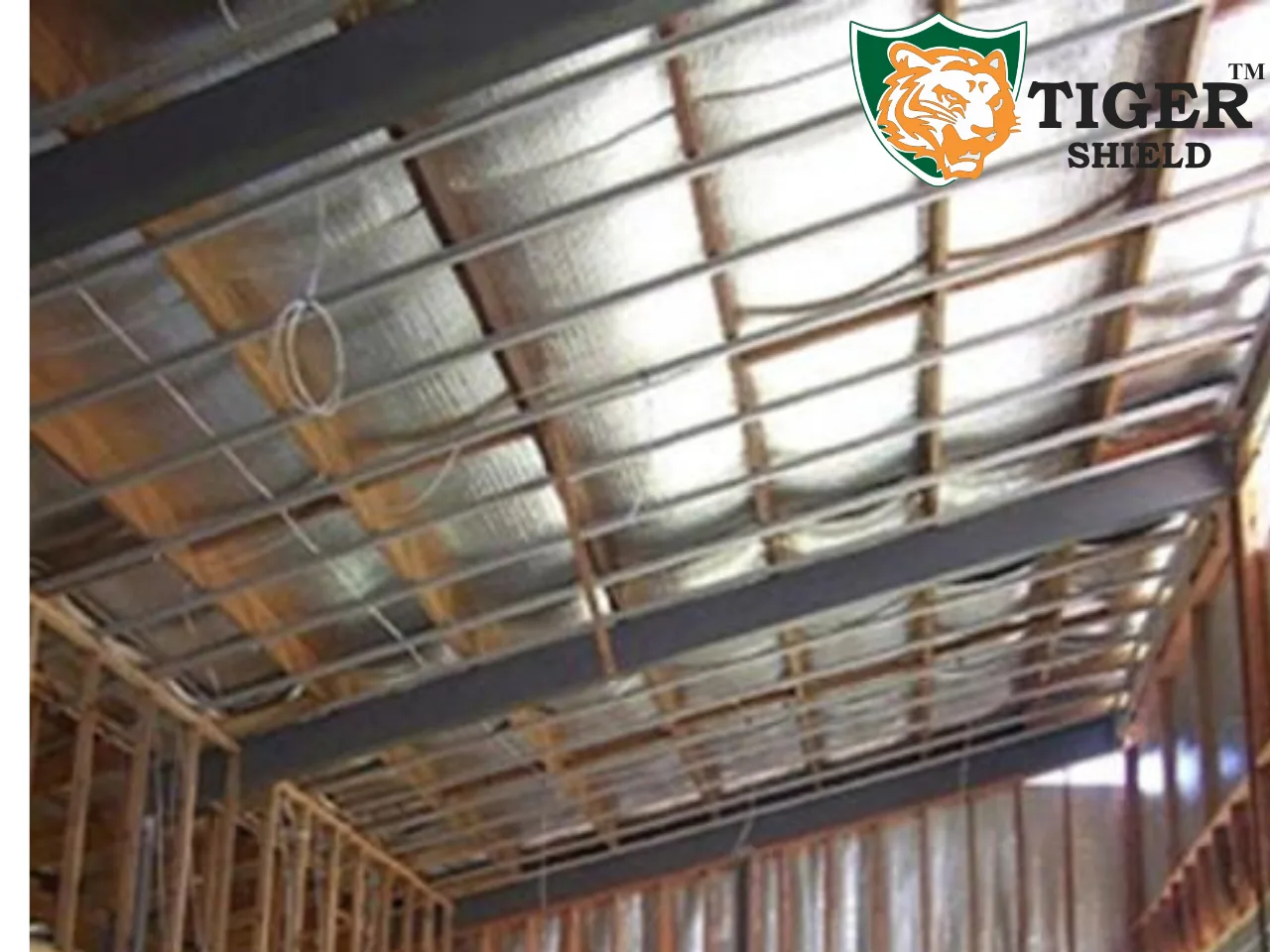
TigerShield™ under deck insulation is a reflective aluminium-foil bubble sheet that gets fastened to the underside of your roof structure. The reflective surface faces downward into the building, bouncing radiant heat back toward the roof before it can transfer into your shop floor or storage area.
- Why You Need Under Deck Insulation
- How TigerShield™ Under Deck Insulation Works
- Three Installation Methods for Under Deck Insulation
Here’s what happens inside an Indian factory or warehouse without under deck insulation:
- Roof absorbs solar heat all day. Metal roof surface temperature crosses 70°C by 2 pm. RCC slab radiates retained heat well into the evening.
- Heat radiates downward. Shop floor temperature rises 8–12°C above ambient outside temperature.
- Productivity drops. Workers slow down. Heat-related fatigue is well-documented in Indian manufacturing studies.
- Equipment fails faster. Electronics, machinery, and lubricants degrade in sustained heat.
- Inventory damage. FMCG, pharmaceuticals, electronics, and packaged food spoil or degrade in storage.
- AC bills explode. If your building is conditioned, cooling load rises 30–50% in summer months.
- Monsoon condensation. The cool underside of metal roofing meets warm humid interior air. Droplets form and rain down onto goods and machinery.
- Rain noise. Bare metal roofs amplify monsoon rain to over 85dB — loud enough to make voice communication impossible.
A properly installed under deck insulation layer addresses every single one of these problems with one product, one installation, one supplier.
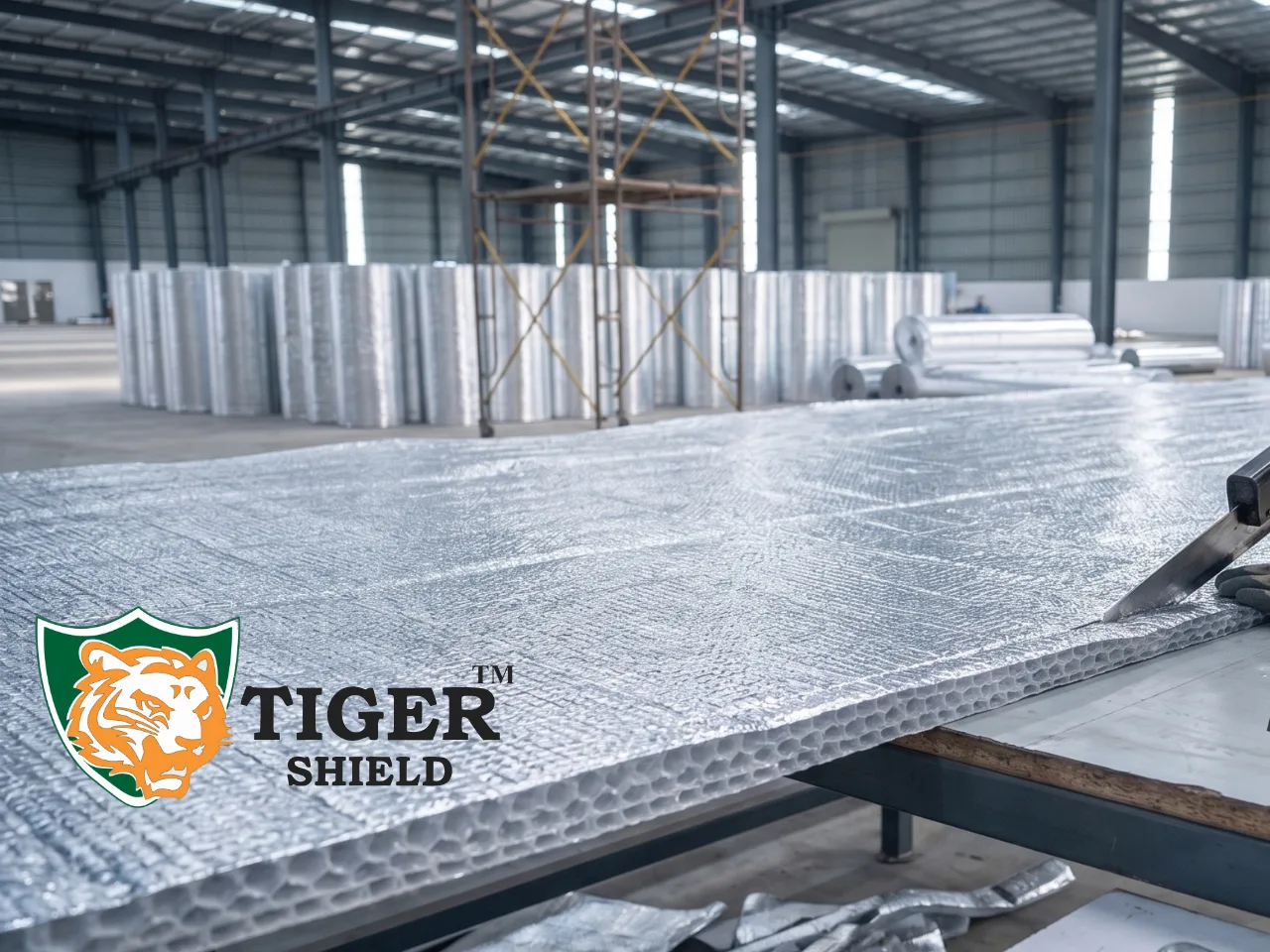
A TigerShield™ under deck insulation sheet is built in three functional layers:
- Top layer (facing roof): Pure aluminium foil with 97% reflectivity. Bounces radiant heat back toward the roof before it enters the building.
- Core layer: Closed-cell polyethylene bubble film. Traps still air inside thousands of sealed bubbles, blocking conductive and convective heat transfer.
- Bottom layer (facing building interior): A second aluminium foil layer (in double-foil variants). Reflects any residual heat and acts as a complete vapour barrier against monsoon condensation.
Combined, the sheet works as a three-mode thermal barrier — reflective, conductive, and convective — in a single lightweight roll that installs in under an hour per 1,000 sqft section.
The right installation method depends on your existing roof type and how exposed the underside is. Our team can recommend based on site photos.
Method 1 — Direct Staple Under Purlin (most common for metal-roof PEB) The insulation roll is unrolled across the underside of the purlins, reflective side facing down. Fixed with a heavy-duty staple gun or roofing nails. Fastest installation method. Best for metal-roof PEB and tin-shed factories.
Method 2 — Spacer + Fastener (for RCC / concrete slabs) Aluminium or PVC spacers are first fixed to the concrete underside at 600mm intervals. The insulation sheet is then fastened to the spacers, creating a small air gap that boosts thermal performance by another 15%. Required for RCC slabs because direct contact reduces reflective performance.
Method 3 — Wire Mesh Suspension (for large open spans) A wire mesh grid is first stretched across the underside of trusses. The insulation is then draped over the mesh, with the mesh supporting any sag. Used in warehouses with very wide column spacings where direct fixing isn’t practical.
For most Indian factory sheds and warehouses, Method 1 (direct staple) is the right choice. For commercial buildings with RCC roofs, Method 2 is standard.
Which TigerShield™ Under Deck Insulation Should You Choose?
| Roof / Building Type | Recommended Product | Thickness | Why |
|---|---|---|---|
| Small under deck retrofit (under 5,000 sqft) | ThermaFlex | 6mm | Cost-effective basic thermal break |
| Standard factory shed under deck | ThermaPrime | 10mm | Best value — double bubble + double foil |
| Large industrial under deck (25,000+ sqft) | ThermaPlus | 12mm | Higher thermal resistance for big spans |
| Hot zone (Rajasthan, Telangana, AP, Gujarat) | ThermaPlus | 12mm | Extra reflectivity for extreme heat |
| Under RCC slab (concrete roof) | ThermaPrime or ThermaPlus | 10mm or 12mm | Concrete retains heat — needs heavier grade |
| Air-conditioned interior | ThermaPlus or ThermaGuard | 12mm or 20mm | Maximises HVAC efficiency, fast payback |
| Cold storage under deck | ThermaGuard | 20mm | Heaviest-duty for sub-zero conditioned interiors |

Under Deck Insulation vs Over-Roof Insulation. Which is Better?
| Factor | Under Deck Insulation | Over-Roof Insulation |
|---|---|---|
| Best for | Existing buildings (retrofit) | New construction |
| Installation time | 1 day per 5,000 sqft | 3–5 days for the same area |
| Requires roof removal | No | Sometimes |
| Disruption to operations | Minimal — work happens inside | High — roof must be opened |
| Thermal performance | Excellent (reflects before re-radiation) | Slightly higher (blocks at source) |
| Best for monsoon condensation | Yes — vapour barrier faces interior | Less effective for condensation |
| Cost | Lower | Higher (labour-intensive) |
| Insulating asbestos roofs | Yes — safest method | Not recommended (asbestos disturbance) |
The honest verdict. For new construction, over-roof insulation has a slight performance edge. For everything else — especially retrofits, asbestos roofs, and operating factories — under deck is the better choice. That’s why 80% of the under deck insulation we ship goes to existing buildings.
Where Under Deck Insulation Is Used
Factory Shed Retrofits The largest single application. Existing PEB factory sheds, tin sheds, and metal-roof structures across Delhi NCR, Haryana, Punjab, and UP routinely add under deck insulation to cut summer heat and reduce cooling costs. → See Factory Shed Insulation
Warehouses & Godowns Stored goods need temperature stability. Under deck insulation in warehouses protects FMCG, pharmaceuticals, electronics, and food inventory from heat damage.
RCC Slab Buildings Concrete roofs absorb and retain solar heat all day, then radiate it into the building well into the evening. Under deck insulation under RCC slabs stops the heat transfer before it reaches occupants below.
Asbestos Sheet Roof Retrofits Old asbestos-roof factories cannot have their roofs modified due to health regulations. Under deck insulation is the only safe way to retrofit these buildings for thermal performance.
Commercial Buildings & Showrooms Auto showrooms, retail outlets, and commercial spaces use under deck insulation to reduce HVAC load and improve customer comfort without modifying the building exterior.
Cold Storage & Refrigerated Units The vapour-barrier property of under deck insulation makes it effective inside cold storage rooms, refrigerated warehouses, and pharma cold chains.
Schools, Hospitals & Institutional Buildings Where roof replacement is impossible due to budget or operations, under deck insulation provides immediate thermal improvement without service disruption.
Why Choose TigerShield™ for Under Deck Insulation
Direct Manufacturer in Faridabad We manufacture every roll at our own facility in Pali Village, Faridabad. Buy direct — lower price, faster dispatch, direct technical support from the team that made the product.
ISO 9001 Certified | MSME Registered | Make in India Every TigerShield™ roll meets ISO 9001 quality standards and is registered under India’s MSME programme.
Retrofit Specialists Our team has supplied under deck insulation for hundreds of operating factory retrofits across Delhi NCR. We know how to schedule installation around your shifts, how to handle dust suppression during install, and how to keep machinery covered during the work.
Same-Week Dispatch — Pan-India Delivery Most Delhi NCR orders ship within 24–48 hours. Other states within 5–7 working days. Cities served: Delhi, Gurgaon, Noida, Ghaziabad, Faridabad, Sonipat, Panipat, Bhiwadi, Alwar, Jaipur, Ludhiana, Chandigarh, Lucknow, Agra, Meerut, Ahmedabad, Mumbai, Pune, Hyderabad, Chennai, Kolkata.
Six Thickness Variants Under One Brand From 4mm to 20mm, single-bubble to double-bubble — one manufacturer, one consistent quality standard.
Free Site Assessment in Delhi NCR Our team will visit your site, measure your roof area, recommend the right product grade, and quote your project — at no cost.
Frequently Asked Questions
- What is the best under deck insulation for an Indian factory?
- Can under deck insulation be installed in an operating factory?
- Does under deck insulation work on RCC concrete roofs?
- How is under deck insulation different from PEB insulation?
For most Indian factory retrofits, TigerShield™ ThermaPrime 10mm (double-bubble + double-foil) is the right default. It balances thermal performance, installation speed, and cost. For hot climate zones (Rajasthan, Telangana, AP) or air-conditioned interiors, step up to ThermaPlus 12mm.
Yes. Under deck insulation is installed from inside the building, so there’s no impact on roof integrity, no exposure to weather, and minimal operational disruption. Most retrofits happen over weekends or during planned maintenance windows. Our installation teams have experience working around active machinery.
Yes — with the right installation method. RCC slabs require a spacer-and-fastener installation (Method 2) that creates an air gap between the concrete and the insulation. This air gap boosts thermal performance by about 15% and is essential for reflective insulation to perform properly under concrete.
PEB insulation is typically installed over the purlins during new PEB construction. Under deck insulation is installed below the existing roof structure usually as a retrofit on an already-built factory or warehouse. The material itself is similar; the installation method differs based on whether you’re insulating during construction or after.
Ready to Cut Your Factory’s Heat Costs?
Manufacturing Facility
Tiger Thermal Insulation co
Pali Village, Haryana 121004